Arrian and the notes
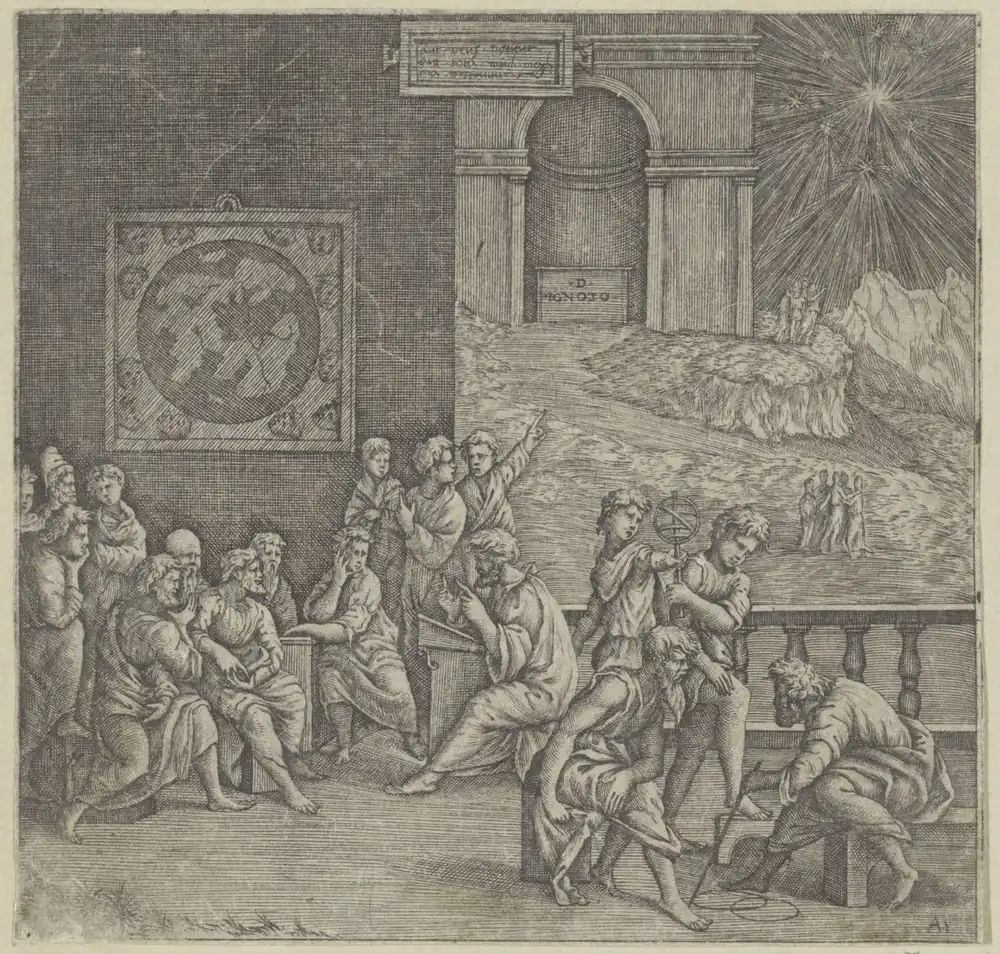
Epictetus never wrote anything down. He taught orally, in Nicopolis, in a school where students stayed for years and where the conversation mattered more than the doctrine.
Among his listeners sat a young man from Nicomedia in Bithynia, Lucius Flavius Arrianus. He took notes. Not in order to publish them, he writes later, but to keep for himself what he had heard.
His dedicatory letter, preserved as the preface, is strikingly defensive. He stresses that he did not want to make a book, that the texts got into circulation without his knowledge, and that these are not his words but his teacher's, written down as literally as possible, spoken idiom included.
That last point is exactly why it works. What stands there does not read as philosophy but as someone talking to you.
What happened next
Arrian afterwards made a career in Roman service. Consul around the year 130, for years governor of Cappadocia under Hadrian, where he repelled an invasion by the Alans. He also wrote the Anabasis of Alexander, still the most reliable source on Alexander the Great.
Of the Discourses there were originally eight books; four survive. The Enchiridion is a summary Arrian distilled from them himself, and it is that summary most readers have ever read.
Marcus Aurelius received the notes on loan from his teacher Rusticus. Without Arrian there would have been no text to lend, and the teaching of a banished slave would never have reached an emperor's study.
The crossroads
You hear something you do not want to forget. Writing it down costs you time and gains you nothing.
The sorting
The tempting sorting is that Arrian was modest. His preface suggests it, but he was also consul and governor, and such men are rarely modest.
What actually happened is more sober. Whether Epictetus would be remembered, whether someone else would do it, and whether his notes would ever mean anything: all outside him. What did lie with him was whether he would write down what he heard, and he did, for himself.
The outcome is the sharpest illustration of the difference between goal and action. His goal was his own memory; the result was that a philosophy survived two thousand years. That result was in no way his achievement, because he was not aiming at it.
And there is a hint in it about what work yields. The best thing you make is often something you do not know at the time is the best thing.
The objection
We have Epictetus only through him, and that is a problem that qualifies the admiration. What we read is what Arrian understood, selected and wrote down; he was not a recording device but a learner with his own preferences. Passages that appealed to him less may have dropped out.
And the sharp version of this lesson, that you should do what is in front of you and leave the outcome, is easily used as an excuse to aim at nothing. Arrian made a career, planned his life and deliberately wrote history. The notes were the exception, not his method.
The question for you
Which knowledge or experience around you exists only inside somebody's head? And what would it cost you to write it down tonight?