Cato and the lost election
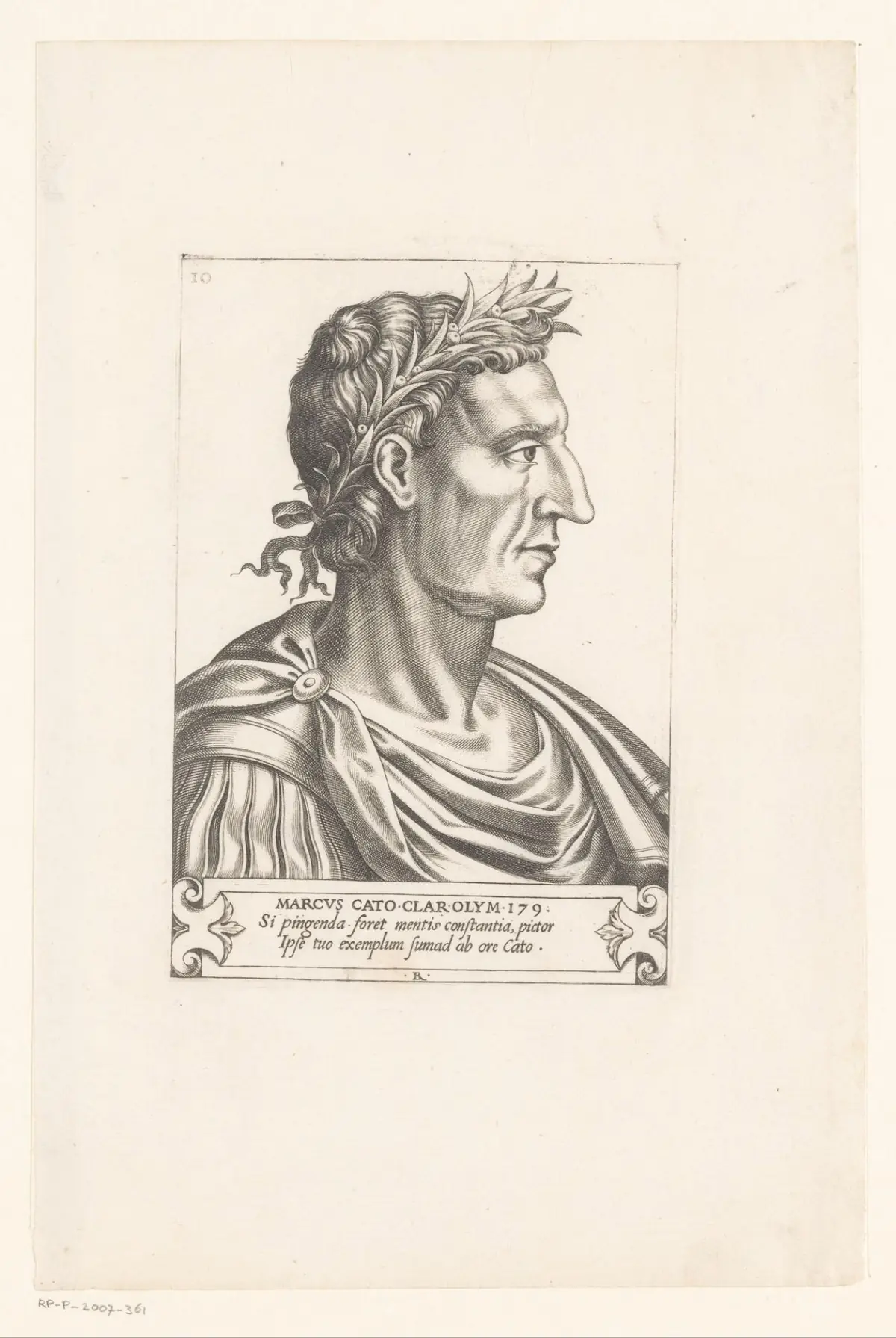
Cato the Younger stood for the consulship of 51 BC, the highest office of the republic. He was the great-grandson of Cato the Elder and counted as the living conscience of Rome.
Buying votes was in those years so ordinary that candidates took out loans for it; there were middlemen who delivered by district. Cato refused. He had moreover as praetor pushed through laws to punish bribery, which endeared him little to exactly those voters.
He lost. His friends were inconsolable; they thought it a scandal for the city. Cato kept to his ordinary daily rhythm. He went walking without shoes, played ball on the Campus Martius, ate, took a bath, and read. When someone asked how he could stay so calm, he answered that he had done everything a candidate ought to do.
What happened next
The republic he went on working for had eight years left. In 49 Caesar crossed the Rubicon and civil war broke out. Cato took the side of the republican institutions against the man who would replace them, and that was not a choice for Pompey, of whom he thought little, but against one-man rule.
After the defeat at Pharsalus he led the remnants of the army through the Libyan desert. In 46, after the final defeat at Thapsus, he died at Utica. Caesar is said to have remarked that he grudged him his death, because Cato had thereby denied him the chance to pardon him.
His name became a symbol afterwards. For Seneca he was the proof that virtue exists; for Lucan the hero of his epic.
The crossroads
You have done everything right and lost, and the reason you lost is precisely the thing you are proud of.
The sorting
The tempting sorting is that Cato did not mind his defeat. Plutarch shows rather that the people around him did mind and that he had to calm them; he was defending a stance, and that takes effort.
The cut sits in his own answer. A candidate can do what a candidate ought to do: make himself available, argue his case, show himself. There his part ends. What the voters decide is theirs, and that does not change because you consider it important.
The sharpness lies in what he could have done. He could have won; there was a path, and it was the usual path. He chose not to take it, and that is a decision inside his box. The result was therefore not a misfortune but a consequence he had accepted in advance.
That the ball game and the bath stuck in the tradition is no accident. Whoever continues his day unchanged shows where the result stood in his order of things.
The objection
There is a real objection that was already made at the time. By not winning, Cato left the office to someone else, and that someone would not defend the republic as he would have. Purity that clears the field for the less pure is an expensive form of being right.
Cicero, who admired him, reproached him with exactly this: he behaved as though he lived in Plato's ideal state rather than in the Rome of Romulus. Whoever wants to be right in a world that does not cooperate has to choose somewhere between his principles and his influence, and Cato consistently chose the first.
The question for you
Where are you playing a game whose rules you actually reject, because losing feels worse than bending? What would it cost to lose the way Cato did?