The circle of control
The circle of control is a drawing of three circles that sorts whatever is on your mind by how much say you have over it: what you control, what you can influence, and what you can only care about. Teachers, coaches and therapists use it because it turns a vague weight into a list you can act on.
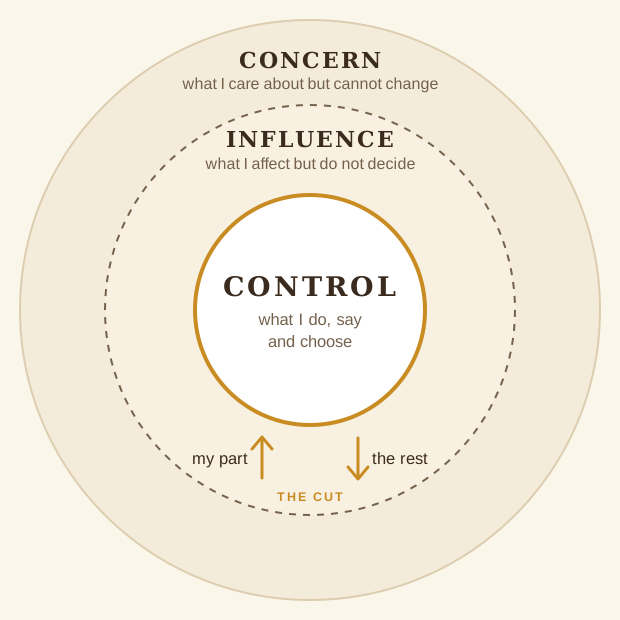
The three circles
Control is the inner circle: what you do, what you say, what you choose, where you put your attention, how you respond. Nobody else has to cooperate for anything in this circle to happen.
Influence is the middle ring: things your actions touch but do not decide. Your child's grades, a colleague's mood, whether the client says yes, your own health. You can push; you cannot guarantee.
Concern is the outer ring: what you care about and cannot change. The weather, the economy, the past, the news, what strangers think of you.
The instruction that comes with the drawing is short: spend your effort from the inside out. Most worry runs the other way, from the outside in.
How to use it
- Empty your head. Write down everything about the situation that weighs on you, one item per line. Do not sort yet.
- Place each item. Ask of each line: can I do this myself, today, without anyone cooperating? Then it is control. Can I push on it without deciding it? Influence. Neither? Concern.
- Cut the middle. Take every item in the influence ring and split it in two: the part you do, and the part that then happens or does not. The first part moves inwards, the second outwards.
- Act on the inner circle. Pick one thing from it and do it today.
- Put the outer ring down. Not because it does not matter, but because carrying it changes nothing about it.
Fill it in here
You can do the whole exercise on this page, with taps only if you like. Nothing is saved; print the result or let it go.
Nothing you tap or type here leaves this page. It is not stored and not sent.
Start with one thing that is on your mind.
The mistake most worksheets make
The middle ring is where the model quietly fails. Being able to influence something feels like having half a grip on it, so you keep holding all of it. Your daughter's exams, your team's result, your partner's mood: they sit in the middle ring for months, and you carry them as if they were yours.
The fix is the cut. An item in the middle ring is never one thing. It is two things that have not been separated yet.
- Offering help once, and meaning it.
- A quiet house in the weeks before.
- My face and my first sentence when the results come.
- Whether she opens the books.
- The marks.
- What she concludes about herself.
After the cut the middle ring is empty. Nothing was lost: everything you could do is still on the page, in the inner circle, and it is now clear that the rest was never yours to carry. This is why the Stoics kept to two categories. On this site the two are called yours and not yours, and the exercise is called the cut.
Examples
At work: a reorganisation has been announced. Control: the quality of my work this week, bringing my CV up to date, asking my manager one direct question. Concern: who decides, what they decide, when they tell us. The item in the middle, whether I keep my job, falls apart into those two lists.
At school: a test on Friday. Control: how I study tonight, when I go to bed, asking the teacher about the part I do not understand. Concern: which questions come up, how the others do. My mark is the item in the middle: the studying moves in, the number moves out.
At home: a parent who is ill. Control: how often I call, what I say, whether I come along to the appointment. Concern: the illness, the test results, how she chooses to deal with it. Her recovery was never one thing.
More worked examples, each with the reasoning per piece, are on the situation pages, such as a restructuring at work, worrying about money and an adult child who chooses differently.
Where it comes from
The drawing goes back to The 7 Habits of Highly Effective People by Stephen Covey, published in 1989. Under the first habit, be proactive, Covey drew two circles: a circle of concern and, inside it, a circle of influence. His point: whoever works on the inner circle sees it grow, and whoever stares at the outer one sees his influence shrink. The third circle, control, is not in the book. Trainers and teachers added it later, and that is the version on most worksheets today.
The idea itself is much older. Around the year 125 Arrian wrote down the handbook of his teacher Epictetus, a former slave, and its first line is the whole model in one sentence:
- Some things are within our power, and some are not.Epictetus, Enchiridion 1
Epictetus had two categories, not three. That difference matters more than it seems, and it explains why the middle ring has to be cut.
The worksheet
Prefer paper? One page, A4, with the three circles, the cut and one line for what you will do today. Free to print and copy for a class, a team or a session.
Download the worksheet (PDF)Practise the sorting
A worksheet works on one situation. The skill underneath it, seeing in the moment what is yours and what is not, comes from repetition. The two minute check gives you ten everyday situations and shows which way you tend to err: carrying what is not yours, or giving away what is. The practice section has hundreds more, free and without an account.
Questions people ask
What is the circle of control?
A drawing of three circles used to sort worries by how much say you have over them. The inner circle holds what you control (your actions, words and choices), the middle ring what you can influence, and the outer ring what you care about but cannot change. The advice is to spend your effort from the inside out.
Who invented the circle of control?
Stephen Covey introduced the circle of concern and the circle of influence in The 7 Habits of Highly Effective People (1989). The third, innermost circle of control was added later by trainers and teachers. The underlying idea is the opening line of the Enchiridion of Epictetus, written down around the year 125.
What is the difference between the circle of control and the circle of influence?
Control is what you can do yourself without anyone cooperating. Influence is what your actions affect without deciding the outcome, such as another person's choice or a result. A useful rule: split every influence item into the part you do, which is control, and the part that follows, which is not.
Is the circle of control a Stoic idea?
The drawing is modern, the idea is Stoic. Epictetus opens his handbook with the line that some things are within our power and some are not. He used two categories rather than three, which is why Stoic practice cuts a mixed situation in two instead of parking it in a middle ring.