Seneca and the charge of wealth
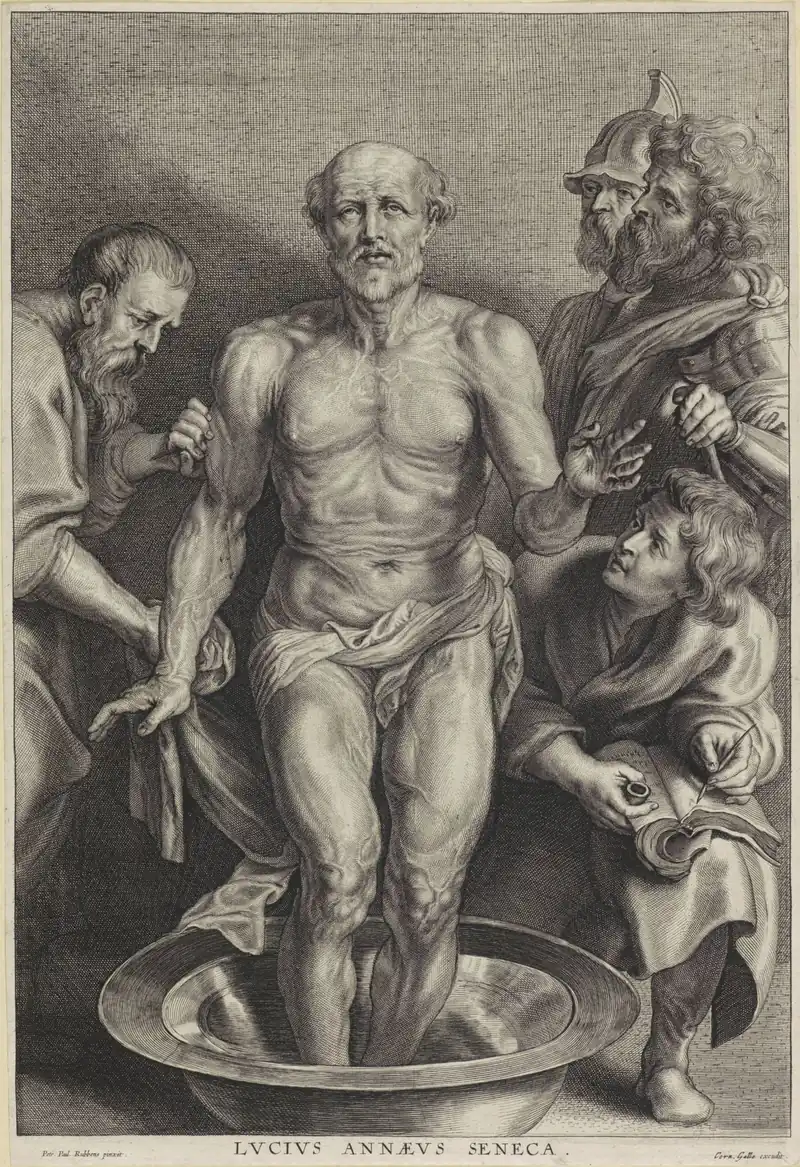
By the year 62 Seneca's position at court had become untenable. His ally Burrus had died, Nero had surrounded himself with new advisers, and there was open whispering about the wealth of the philosopher who preached moderation.
That wealth was genuinely vast. Ancient sources name a fortune of three hundred million sesterces, built from estates, vineyards and loans outstanding as far as Britain. His opponents asked how a man who writes that possessions are indifferent can accumulate so many of them.
He asked Nero for an audience. Tacitus reproduces both speeches almost verbatim. Seneca offered to hand his entire fortune back to the emperor and withdraw: everything he had, he had received from Nero, and he no longer carried it well. Nero refused, with warm words and an embrace.
What happened next
Seneca withdrew anyway. He received hardly any visitors, reported himself ill, and stayed away from court.
In the three years that followed he wrote his major work: the one hundred and twenty-four letters to Lucilius and the Natural Questions. They are the texts to which he owes his place in history, and they were written by a man who knew his time was up.
In 65 he was linked to Piso's conspiracy and Nero ordered him to die. Whether he was actually involved has never been established.
The crossroads
You are attacked over something where the attack has a point, by people who do not mean it.
The sorting
The tempting sorting is that Seneca was either right or a hypocrite. Both are too easy.
The teaching itself is clear: possessions are an indifferent, and you may have them as long as you do not need them. Seneca appeals to that, and it is a valid appeal. But he also knows the question is not about the teaching but about him, and that is precisely the part he cannot win.
The cut he makes is therefore practical. What people thought of him and whether Nero believed him did not lie with him; he could not kill the rumour. What did lie with him was whether he would offer the money, and he did. Nero's refusal made him no less sincere, only less credible.
And there is a bitter confirmation in what followed. He could not rid himself of his fortune, but he could walk away from court and write. That is what he did, and that is what remained.
The objection
The most honest objection is that he stayed too long. He served an emperor who had his mother killed and wrote the justification of it to the Senate. He later argued that from inside he had prevented worse, and that is an argument any accomplice can use.
What nevertheless stands is that he wrote it down himself. His letters are not the report of a man who can do it, but of a man attempting it and repeatedly finding that he falls short. As an example he is mediocre. As a witness he is more exact than anyone.
The question for you
Where is the gap in your life between what you believe and how you live? And if you cannot close it in one move: what is the inner withdrawal that is possible today?