Boethius and the wheel
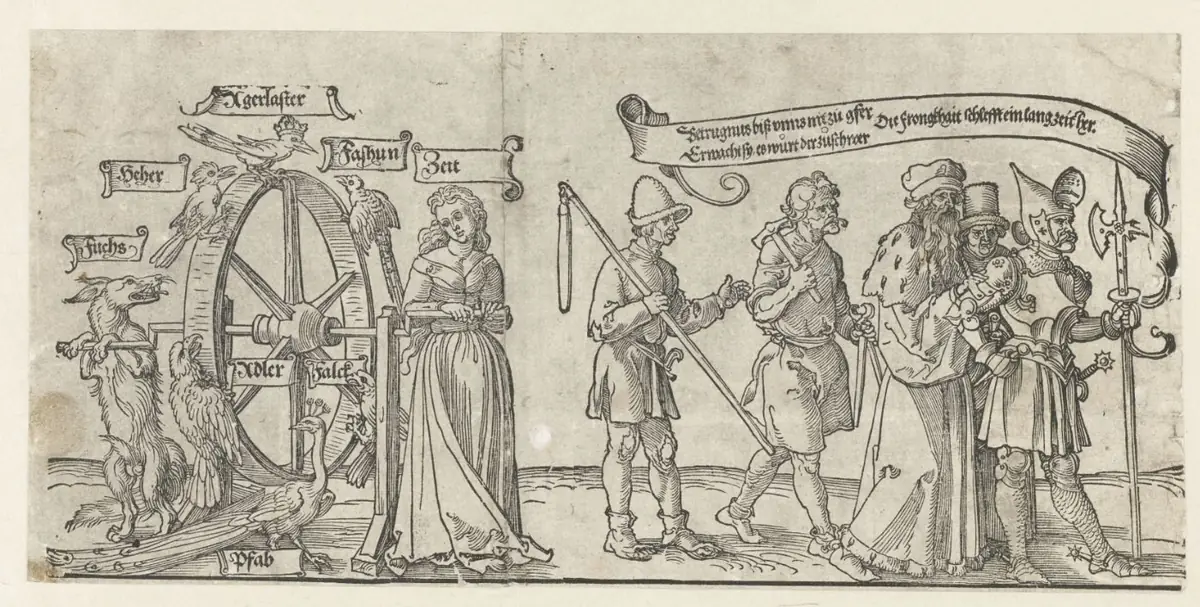
Boethius was the highest official of the court at Ravenna, in an Italy ruled by the Ostrogothic king Theoderic. He came from one of Rome's oldest senatorial families, was a translator of Aristotle, and saw his two sons appointed consul in the same year. Few lives ran so favourably.
The tide turned when he defended a senator against a charge of treason. Shortly afterwards he was the accused himself: conspiring with the Eastern Roman court at Constantinople. He was imprisoned without a hearing at Pavia, hundreds of miles from home, awaiting execution.
There he wrote down a conversation between himself and Philosophy, who appears to him as a woman and rebukes him for sitting there complaining. Her central image is a wheel. Fortune turns it, and whoever climbs on knows that it turns.
What happened next
He was executed around the year 524. The book he wrote in his cell, The Consolation of Philosophy, is composed in alternating prose and verse, a form known as Menippean satire. It became one of the most read texts in Europe; for over a thousand years it stood in virtually every library of significance.
The list of those who translated it is remarkable: King Alfred the Great into Old English, Chaucer into Middle English, and Queen Elizabeth I by hand. Dante placed him in heaven.
The book nowhere names Christ, although Boethius was a Christian and theological treatises stand in his name. In his final weeks he drew not on his faith but on pagan philosophy, and nobody knows exactly why.
The crossroads
Everything you had has been taken from you by a decision you were not present for. You have a few months left and nothing to do.
The sorting
The tempting sorting is that Fortune was unfair. Philosophy gives the answer in the book that turns the whole case around: she was in fact perfectly fair, because she never promised anything other than turning. Whoever steps onto the wheel to rise has thereby agreed also to fall.
The cut is therefore sharper than it looks. His office, his fortune, his reputation and the king's favour were never property but a loan; he had accepted them on terms he had not read. Taking them back is not injustice but the agreement.
What was his remained in the cell: his judgment, and what he did with his last months. He chose to write.
The force of the image lies in its inevitability. You can only get off the wheel by never climbing on, and that means forgoing everything it has to offer.
The objection
The wheel is a fine image that easily explains too much. Not every loss is a reversal of fortune: there are unjust trials, corrupt courts and people who lie, and Boethius was the victim of exactly that. Attributing everything to a turning wheel is also a way of leaving out blame where it belongs.
The book, incidentally, does not quite do that itself. Boethius maintains that he is innocent and that his accusers lied. The consolation is not about who was right, but about what he could still do while being found wrong.
The question for you
If you knew you had six months left, what would you finish? And what is stopping you from starting it next week?